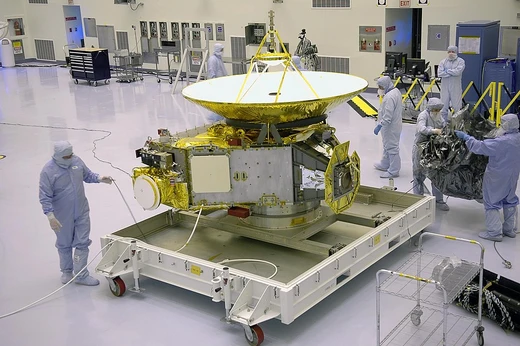
Mechanical engineering
One of the oldest and broadest engineering branches.

Saiphani02 · CC BY-SA 4.0
Mechanical engineering is the study of physical machines and mechanisms that may involve force and movement. It is an engineering branch that combines engineering physics and mathematics principles with materials science to design, analyze, manufacture, and maintain mechanical systems. It is one of the oldest and broadest of the engineering branches.
- field
- Mechanical engineering
- known_for
- Design and analysis of mechanical systems, including machines, vehicles, and industrial equipment
- earliest_known_developments
- Ancient Near East (wedge, inclined plane, wheel, lever, pulley)
- emerged_as_formal_field
- Industrial Revolution in Europe, 18th century
Lore & Background
The application of mechanical engineering can be seen in the archives of various ancient and medieval societies. The six classic simple machines were known in the ancient Near East. The wedge and the inclined plane were known since prehistoric times. Mesopotamian civilization is credited with the invention of the wheel by several, mainly old sources, though some recent sources suggest independent invention in both Mesopotamia and Eastern Europe or credit prehistoric Eastern Europeans. The lever mechanism first appeared around 5,000 years ago in the Near East, used in a simple balance scale and to move large objects in ancient Egyptian technology. The lever was also used in the shadoof water-lifting device, which originated in ancient Egypt around 2000 BC. The earliest evidence of pulleys dates back to Mesopotamia in the early 2nd millennium BC.
Reader's Guide
Mechanical engineering emerged as a field during the Industrial Revolution in Europe in the 18th century, though its development can be traced back several thousand years around the world. In the 19th century, developments in physics led to the development of mechanical engineering science. The field has continually evolved to incorporate advancements; today mechanical engineers pursue developments in areas such as composites, mechatronics, and nanotechnology. Mechanical engineering overlaps with aerospace engineering, metallurgical engineering, civil engineering, structural engineering, electrical engineering, manufacturing engineering, chemical engineering, industrial engineering, and other engineering disciplines. Mechanical engineers may also work in biomedical engineering, specifically with biomechanics, transport phenomena, biomechatronics, bionanotechnology, and modelling of biological systems. Education in mechanical engineering has historically been based on a strong foundation in mathematics and science.
Did You Know?
- The earliest practical water-powered machines, the water wheel and watermill, first appeared in the Greek world (e.g., the Perachora wheel, 3rd century BC) and later Roman times.
- Heron of Alexandria created the first steam-powered device, the Aeolipile, in Roman Egypt around 10–70 AD.
From Venice to the Assembly Line: A Historical Arc
The story of manufacturing engineering stretches back far beyond the Industrial Revolution. Centuries later, several sites in Britain and the Americas are credited with launching the modern factory era. Henry Ford then reshaped the entire paradigm in the early twentieth century by introducing mass production with specialized workers along rolling ramps, slashing costs and ushering in the consumer age.
Defining the Discipline: Scope and Interdisciplinary Roots
Manufacturing engineering occupies a distinctive position at the intersection of several professional fields. While it draws heavily on the core competencies of mechanical and industrial engineering, it also weaves in elements of mechatronics, commerce, economics, and business management, making it a genuinely interdisciplinary pursuit. The discipline is often classified as a subdiscipline of both industrial engineering and systems engineering, with very strong overlaps into mechanical engineering. At its heart, the manufacturing engineer's task is to transform raw material into a new or updated product in the most effective, efficient, and economically sound manner. This requires the ability to plan manufacturing practices, research and develop tools, processes, machines, and equipment, and integrate the various facilities and systems needed to produce quality goods while keeping capital expenditure optimal. A practical illustration might be a company deploying computer-integrated technology to accelerate output while reducing reliance on manual labor. The field is remarkably broad, encompassing everything from the design and development of physical artifacts and production processes to the creation of entirely new technologies.
The Automation and Quality Revolution
The field expanded dramatically beginning in the 1960s, when industrialized nations began equipping factories with numerical-control machine tools and automated production systems. A parallel breakthrough came in quality management: American electrical engineer William Edwards Deming pioneered advanced statistical methods of quality control that were initially overlooked in his own country but later transformed Japanese factories into global leaders in both cost-effectiveness and production quality. The late 1970s brought another leap with the introduction of industrial robots onto the factory floor. These computer-controlled welding arms and grippers could perform repetitive tasks—such as attaching a car door—quickly, flawlessly, and around the clock, cutting labor costs and boosting production speed. In modern practice, automation permeates processes like machining and welding, delivering higher consistency, shorter lead times, simplified production flows, reduced material handling, and even improved worker morale. Robotics, grounded in mechatronics, employs kinematics to define a robot's range of motion and mechanics to manage internal stresses. Preprogrammed robots now handle tasks that are too dangerous, too unpleasant, or too precise for human operators, allowing businesses to save on labor while maintaining or exceeding quality standards.
Legacy and the Broader Impact on Innovation
The work of manufacturing engineers carries consequences that extend well beyond the factory walls. Their success or failure directly shapes the pace of technological advancement and the spread of innovation across society. When Ford's mass-production model slashed the cost of automobiles, it catalyzed a broader consumer age in which virtually all manufactured goods became more accessible. Decades later, the statistical quality-control methods that Deming championed helped Japanese manufacturers achieve world-leading cost-effectiveness and product quality, reshaping global competitive dynamics. Today, the discipline's modern studies encompass every intermediate process required to produce and integrate a product's components; in industries such as semiconductors and steel, these processes are often termed fabrication. The cumulative effect is a manufacturing ecosystem in which robots can perform tasks too hazardous or too precise for human hands, automation streamlines workflows from raw input to finished output, and the entire production chain operates with a level of consistency and speed that would have been unimaginable to the artisans of the nineteenth century. In this sense, manufacturing engineering remains the quiet engine behind the material progress of modern civilization.
Gallery




Frequently Asked Questions
Who is Mechanical engineering?
Mechanical engineering is the branch of engineering devoted to designing, analyzing, and maintaining physical machines and systems that involve force and motion. It sits at the intersection of physics, mathematics, and materials science, making it one of the oldest and widest-ranging disciplines in the engineering canon.
What are Mechanical engineering's powers/role?
Its core role spans the full lifecycle of mechanical systems—from initial concept and design through manufacturing and ongoing upkeep—covering vehicles, industrial equipment, and small mechanisms alike. It draws on engineering physics, math, and materials knowledge to turn theoretical principles into working hardware.
How does Mechanical engineering's story end?
It doesn't—it remains an active, evolving discipline with no fixed conclusion. As new materials, computational tools, and manufacturing techniques emerge, the field continuously expands its scope rather than reaching a final chapter.
Why is Mechanical engineering important?
Because virtually every physical machine, vehicle, and piece of industrial equipment in the modern world relies on the principles it codifies. Its extraordinary breadth and longevity make it a foundational pillar that underpins nearly every other applied engineering branch.
More in Manufacturing & Materials 1-20
Spotted an error? Know more?
This is a living reference — every entry is fact-audited, and reader corrections feed straight into our audit queue. Suggest an edit · See this site's audit record