Machine
A system using power to apply forces and control movement.

Miguel Angel Omaña Rojas · CC BY 4.0
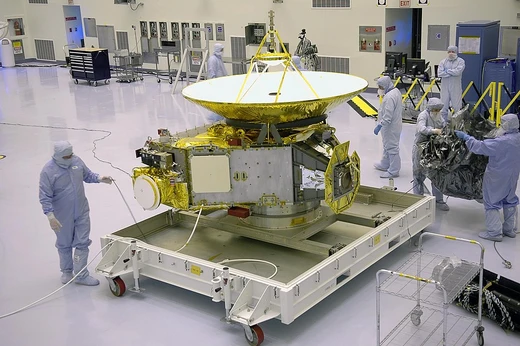
A machine is a thermodynamic system that uses power to apply forces and control movement to perform an action. The term is commonly applied to artificial devices, such as those employing engines or motors, but also to natural biological macromolecules, such as molecular machines. Machines can be driven by animals and human power, by natural forces such as wind and water, and by chemical, thermal, or electrical power, and include a system of mechanisms that shape the actuator input to achieve a specific application of output forces and movement. They can also include computers and sensors that monitor performance and plan movement, often called mechanical systems.
- field
- Mechanics, Engineering
- known_for
- Transforming power into controlled movement; six simple machines (lever, pulley, screw, wheel and axle, wedge, inclined plane); mechanical advantage
Lore & Background
Renaissance natural philosophers identified six simple machines which were the elementary devices that put a load into motion, and calculated the ratio of output force to input force, known today as mechanical advantage. The hand axe, made by chipping flint to form a wedge, is a very early example of a wedge, which along with the inclined plane is among the oldest simple machines. The other five simple machines were invented in the ancient Near East: the wheel and axle in Mesopotamia during the 4th millennium BC, the lever in antiquity (with no widely accepted specific date), pulleys (the earliest known compound pulley is attributed to Archimedes in the 3rd century BC), and the screw attributed to Archimedes in the 3rd century BC. Three of the simple machines were studied and described by Greek philosopher Archimedes around the 3rd century BC: the lever, pulley and screw. Archimedes discovered the principle of mechanical advantage in the lever. Later Greek philosophers defined the classic five simple machines (excluding the inclined plane) and described their mechanical advantage qualitatively, not with precise calculations. Hero of Alexandria (c. 10–75 AD) in his work Mechanics lists five mechanisms that can 'set a load in motion': lever, windlass, pulley, wedge, and screw. The earliest practical wind-powered machines, the windmill and wind pump, first appeared in the Muslim world during the Islamic Golden Age by the 9th century AD. However, the earliest known windmills from that period were vertical-axis grain mills, not wind pumps, which developed later.
Reader's Guide
The concept of the machine is fundamental to human civilization, enabling the amplification of force and the control of movement to perform work. From the simple wedge of a hand axe to complex modern systems like robots and vehicles, machines have transformed agriculture, manufacturing, transportation, and daily life. The identification of six simple machines by Renaissance natural philosophers provided a framework for understanding mechanical advantage, which was later refined by scientists such as Simon Stevin and Galileo Galilei, who showed that machines do not create energy but merely transform it. Modern machines now include computers and sensors, forming mechanical systems that monitor and plan movement, and are ubiquitous in vehicles, appliances, and factory automation. The legacy of machines is their role as tools that extend human capability, a principle that continues to evolve with technological advances.
Did You Know?
- The hand axe is a very early example of a wedge, which along with the inclined plane is among the oldest simple machines.
- The wheel and axle mechanism was invented in Mesopotamia during the 4th millennium BC.
- The earliest programmable machines were developed in the Muslim world, including a music sequencer by the Banu Musa brothers in the 9th century.
- Galileo Galilei was the first to understand that simple machines do not create energy, they merely transform it.
Defining the Craft: Subtractive Manufacturing and Its Scope
Machining stands as one of the most fundamental methods for shaping manufactured parts, defined by the deliberate and controlled removal of material from a larger raw stock to produce a desired geometry. While metal is the most common workpiece material, the process extends well beyond it, finding application in wood, plastic, ceramic, and composite substrates. What distinguishes machining from other manufacturing paradigms is its classification as subtractive manufacturing: rather than building a part layer by layer through additive techniques such as 3D printing, a machinist carves away everything that does not belong. The practitioner who carries out this work is known as a machinist, and the commercial setting in which the work takes place is typically a machine shop—a facility comprising one or more workrooms housing primary machine tools. These shops may operate as independent businesses or exist as internal tool rooms embedded within larger manufacturing organizations to support their specialized production needs. The result is a process that has remained central to producing precision metal components across virtually every industrial sector.
A Term in Motion: How Machining Evolved Over Two Centuries
The word machining carries a history that mirrors the broader trajectory of industrial technology. In the eighteenth century, a machinist was simply someone who constructed or repaired machines, working primarily by hand through processes like carving wood or hand-filing metal. Figures such as James Watt and John Wilkinson, who built new kinds of engines, would have fit that broad definition. Notably, the noun machine tool and the verb to machine did not yet exist in the language. It was not until roughly the mid-twentieth century that those terms were coined, at which point machining came to describe what we now recognize as traditional processes: turning, boring, drilling, milling, broaching, sawing, shaping, planing, abrasive cutting, reaming, and tapping. The post–World War II era introduced a wave of non-traditional techniques—electrical discharge, electrochemical, electron beam, photochemical, and ultrasonic machining—prompting the use of conventional machining as a distinguishing label. More recently, as additive manufacturing moved beyond prototyping into standard production, the phrase subtractive manufacturing emerged as a logical counterpart, though the older, more familiar term machining continues to dominate everyday usage.
The Anatomy of a Cut: Tools, Geometry, and Chip Formation
At the heart of every machining operation lies the cutting tool, a device constructed from a material harder than the workpiece and featuring one or more sharp edges designed to separate a chip from the parent stock. Two critical surfaces define the tool's geometry: the rake face, which channels the newly formed chip away at an angle measured relative to a plane perpendicular to the work surface, and the flank, which maintains a clearance between the tool and the freshly machined surface to prevent abrasive damage. Tools fall into two broad categories. Single-point tools, with one cutting edge, handle operations like turning, boring, and planing, while multiple-cutting-edge tools—used in drilling and milling—typically achieve their relative motion by rotation. The act of cutting itself generates chips through severe plastic deformation in the primary shear zone ahead of the tool. Whether those chips emerge as continuous ribbons, segmented pieces, or discontinuous fragments depends on the interplay of cutting parameters, tool geometry, and the microstructure of the material being worked.
Operations, Motion, and the CNC Revolution
Machining operations are broadly divided into traditional and non-traditional categories, with the traditional set further organized by the geometry they produce. Circular-shape operations include turning, boring, drilling, reaming, and threading, while operations yielding various or straight profiles encompass milling, broaching, sawing, grinding, and shaping. In every traditional operation, relative motion between the tool and the workpiece is essential; this motion is typically achieved by moving either the cutting device or the work itself through lateral rotary or linear paths. The specific shape of the tool, the nature of its relative movement, and the depth of its penetration into the work collectively determine the final geometry of the machined surface. In non-traditional processes such as electrical discharge machining, material removal is accomplished through means other than mechanical cutting, such as electric current. In modern practice, much of this work is governed by computer numerical control, in which computers direct the movement and operation of mills, lathes, and other cutting machines, transforming what was once a purely manual craft into a precisely programmed discipline.
Gallery

Frequently Asked Questions
What is Machine in the context of mechanics and engineering?
Machine is a thermodynamic system that takes an input of power and converts it into controlled forces and movement to carry out a specific task. It encompasses everything from simple hand tools to complex motor-driven assemblies and even biological macromolecules that function at the molecular scale.
What are the six simple machines that form the foundation of Machine?
The six classical simple machines are the lever, pulley, screw, wheel and axle, wedge, and inclined plane. Each one redirects or multiplies an applied force, and more complex machines are built by combining these basic elements.
What kinds of energy sources can drive a Machine?
Machines can be powered by human or animal effort, natural forces like wind and flowing water, or by chemical, thermal, and electrical energy. The specific source simply feeds the actuator, while the machine's mechanism shapes that input into the desired output motion and force.
How does Machine provide mechanical advantage?
By using a system of mechanisms—gears, linkages, cams, or the six simple elements—a machine trades distance or speed for a greater output force (or vice versa). This trade-off is what engineers call mechanical advantage, and it lets a small input produce a much larger, more precisely directed action.
Is Machine only an artificial, human-made concept?
No. While the term most often refers to engineered devices with engines, motors, sensors, and computers, the same definition applies to natural biological structures such as molecular machines inside cells. Any system that channels power into controlled force and motion qualifies as a machine, regardless of whether it was designed or evolved.
More in Manufacturing & Materials 1-20
Spotted an error? Know more?
This is a living reference — every entry is fact-audited, and reader corrections feed straight into our audit queue. Suggest an edit · See this site's audit record